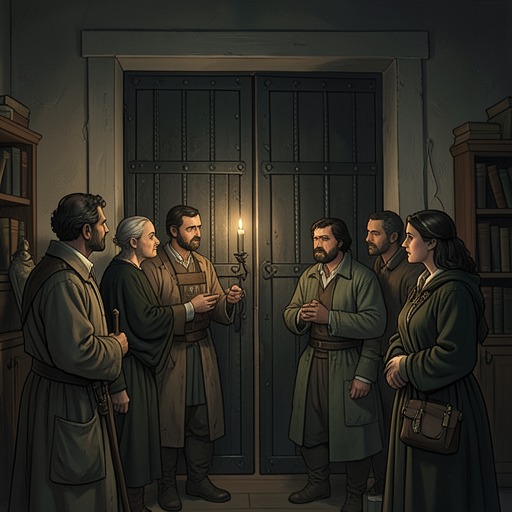
Overthrow the Roman Kingdom
The Social ContractThe expulsion of the Tarquins marks, in Jean-Jacques Rousseau’s account, a rare political rebirth: Rome emerged from the overthrow of its kings with the renewed vigor of a state made young again. The event serves less as a narrated episode than as a hinge in his argument about when a people can regain liberty, how political communities are constituted, and why their institutions remain vulnerable to decay.
Upheaval and Political Renewal
Rousseau places Rome after the Tarquins among the exceptional states that, following violence and revolution, seemed to rise from their ashes with the strength of youth. The parallel examples are Sparta in the time of Lycurgus, and Holland and Switzerland after the expulsion of their tyrants. In this comparison, the overthrow is significant not simply as a change of rulers but as a moment when horror of the past can replace a people’s ordinary forgetfulness and make a new political beginning possible.
That renewal is not a general promise of revolution. Rousseau stresses that such moments are rare and arise from the particular constitution of the state. A people may free itself while it remains politically vigorous, but once its civic impulse has lost force, disturbances may destroy it without restoring liberty. The Roman example therefore illustrates a possibility with strict limits: liberty may be won, but a people cannot assume that it can recover it after its political capacities have faded.
Rome’s Early Political Organization
Rousseau connects the period after Rome’s foundation to the institutions of the new republic, described as the army of its founder and composed of Albans, Sabines, and foreigners. This population was organized into three tribes; each tribe was divided into ten curiae, and each curia into decuriae. Their leaders bore the titles of curiones and decuriones. The account presents this arrangement as an early structure joining Rome’s military origins to its political organization.
Each tribe also supplied one hundred Equites, or Knights, grouped as a century. Rousseau takes this military feature as evidence that the divisions were initially more suited to an army than to a town. He interprets Rome’s early organization as anticipating the demands of a much greater political future: even while it was a small township, Rome had a system that could serve the capital of a wider world.
The Tarquins in Rousseau’s Political Argument
Rousseau’s discussion does not recount the circumstances of the Tarquins’ expulsion or identify individual actions within it. Instead, the event functions as a historical marker in an argument about the conditions under which a state can be renewed. He places it beside other rare cases of political recovery, while warning that the same kind of upheaval cannot reliably happen twice to the same people. The event’s importance lies in this tension between the possibility of rebirth and the fragility of the civic conditions that make it possible.
The broader argument also cautions against treating political authority as justified merely because it exists in fact. Rousseau criticizes Hugo Grotius for reasoning from established power to right, a method he considers especially favorable to tyrants. Against that logic, the Roman turning point belongs to a distinction between rulers’ power and a people’s political standing: the removal of kings can exemplify a recovery of liberty, but the historical occurrence of such a change is not, by itself, a complete theory of legitimate government.
Scale, Government, and the Risk of Decline
The Roman example sits within Rousseau’s larger account of how a state’s form must suit its size and population. He argues that a body politic has a maximum strength it cannot exceed without losing effectiveness: as the social bond extends, it relaxes, and a small state is generally stronger in proportion than a great one. Distance makes administration more burdensome, adding layers of authority and expense that drain the people while leaving fewer resources for emergencies.
Territory and population must also stand in a workable relation. Land must be sufficient to sustain its inhabitants, while the number of inhabitants should not exceed what the land can maintain. Excessive territory is difficult to guard and may provoke defensive wars; insufficient land can make a state dependent on neighbors and draw it toward offensive wars. These claims help frame Rome’s political history as a question of institutional fitness and capacity, rather than as a sequence of rulers alone.
Rousseau further holds that governments tend to contract from the many to the few, moving from democracy to aristocracy and then to monarchy. As the government’s particular will presses continually against the general will, the constitution changes until the ruler may suppress the sovereign people and break the social compact. The expulsion of the Tarquins thus stands at the hopeful end of a political possibility that Rousseau’s wider theory also treats as unstable: a state may recover youthful vigor, but no founding or liberation removes the ongoing danger of government turning against the people.
Religion and the Foundations of Political Order
Rousseau’s reflections on political origins also distinguish religious forms according to their relation to society. He describes an early condition in which peoples had gods as rulers and theocracy as government; because separate peoples treated themselves as politically distinct, they also developed separate gods, encouraging theological and civil intolerance. He then distinguishes the religion of the individual, centered on inward worship and moral obligations, from the religion of the citizen, which gives a particular nation its gods, rites, and legally prescribed public worship.
This discussion clarifies the difference between explaining the force that can establish institutions and endorsing every means used to secure obedience. Rousseau argues that a legislator may invoke divine authority because a people not yet formed by laws cannot always be moved by abstract reason or by force alone. But the durability of institutions, in his account, depends on wisdom rather than passing tricks or imposture. In the context of Rome’s rebirth, religion and founding authority belong to the larger problem of how a political community acquires cohesion; neither substitutes for the civic conditions that allow liberty to endure.